
In July 1946, a few centimeters of fabric were enough to shake up conventions. 80 years later, the bikini has become much more than just a swimsuit: a fashion icon, a symbol of freedom, and one of the most emblematic pieces in the female wardrobe.
From its creation at the Molitor pool to its status as a timeless classic, we look back at the history of a two-piece that has profoundly transformed our relationship with the body, femininity, and movement.
Who invented the bikini?

The creation of the bikini in 1946
At the time, women's swimsuits remained relatively modest. Some reached down to the thighs, while others still covered the stomach. Louis Réard then decided to reduce the amount of fabric to its strict minimum and conceived a model composed of two pieces: a bra and panties that revealed the navel—a first in the history of beachwear.
On July 5, 1946, at the Molitor pool, a few centimeters of fabric were enough to cause a genuine cultural earthquake. Without knowing it, Louis Réard had just given birth to one of the greatest revolutions in the female wardrobe.
Why is the bikini called a "bikini"?
The name of the bikini refers to the Bikini Atoll in the Marshall Islands, where the United States was conducting nuclear tests at the time.
Louis Réard was convinced that his creation would produce an equally explosive effect on public opinion. He therefore chose this name in the hope of provoking a true "detonation" in the fashion world. He was not mistaken.
The audacity of a revolutionary swimsuit
During its official presentation, most models refused to wear a garment deemed far too daring. Louis Réard then turned to Micheline Bernardini, a dancer at the Casino de Paris, who agreed to model in the tiny two-piece.
The international press immediately seized upon the subject. Deemed indecent, the bikini was banned in several countries and on numerous European beaches.
To many, it was provocative. To others, it already heralded a new way of inhabiting one's body and femininity. Behind the controversy, a revolution was underway.
How did the bikini become a fashion phenomenon?
It would take until the 1950s for the bikini to gradually enter popular culture.
In 1953, Brigitte Bardot appeared in a bikini on the beaches of Cannes and, a few years later, in the film And God... Created Woman.
Her free and radiant allure contributed greatly to popularizing this new swimsuit.
In 1962, another image entered history: Ursula Andress emerged from the water wearing a white bikini in Dr. No. This scene became one of the most iconic in cinema and definitively propelled the bikini to the rank of a global phenomenon.
From then on, the two-piece established itself as a summer wardrobe essential.

The arrival of the bikini in fashion houses
Starting in the 1970s, major fashion houses and ready-to-wear brands took up the bikini in their turn.
It was no longer just a swimsuit. It became a field of expression for designers. Fabrics diversified, cuts became sophisticated, and the two-piece established itself as a true fashion piece, reinvented season after season.
Still today, it continues to inspire designers who reinvent it through new lines, couture details, and technical innovations.
The bikini, symbol of female emancipation
More than just beachwear, the bikini has accompanied the major evolutions of society. By revealing the female body at a time when certain parts, such as the navel, were still considered taboo, it helped to change mentalities and representations of femininity.
Over the decades, every woman has made it her own in her own way. Minimalist, high-waisted, asymmetrical, or sporty, the two-piece is constantly reinvented, allowing everyone the freedom to choose the silhouette that suits them.

Our interpretation of the two-piece
Since our first collections at CHLORE, the two-piece has been an integral part of our aquatic wardrobe.
We reinterpret it through our own unique vision: that of a swimsuit designed to combine aesthetics, technicality, and performance.
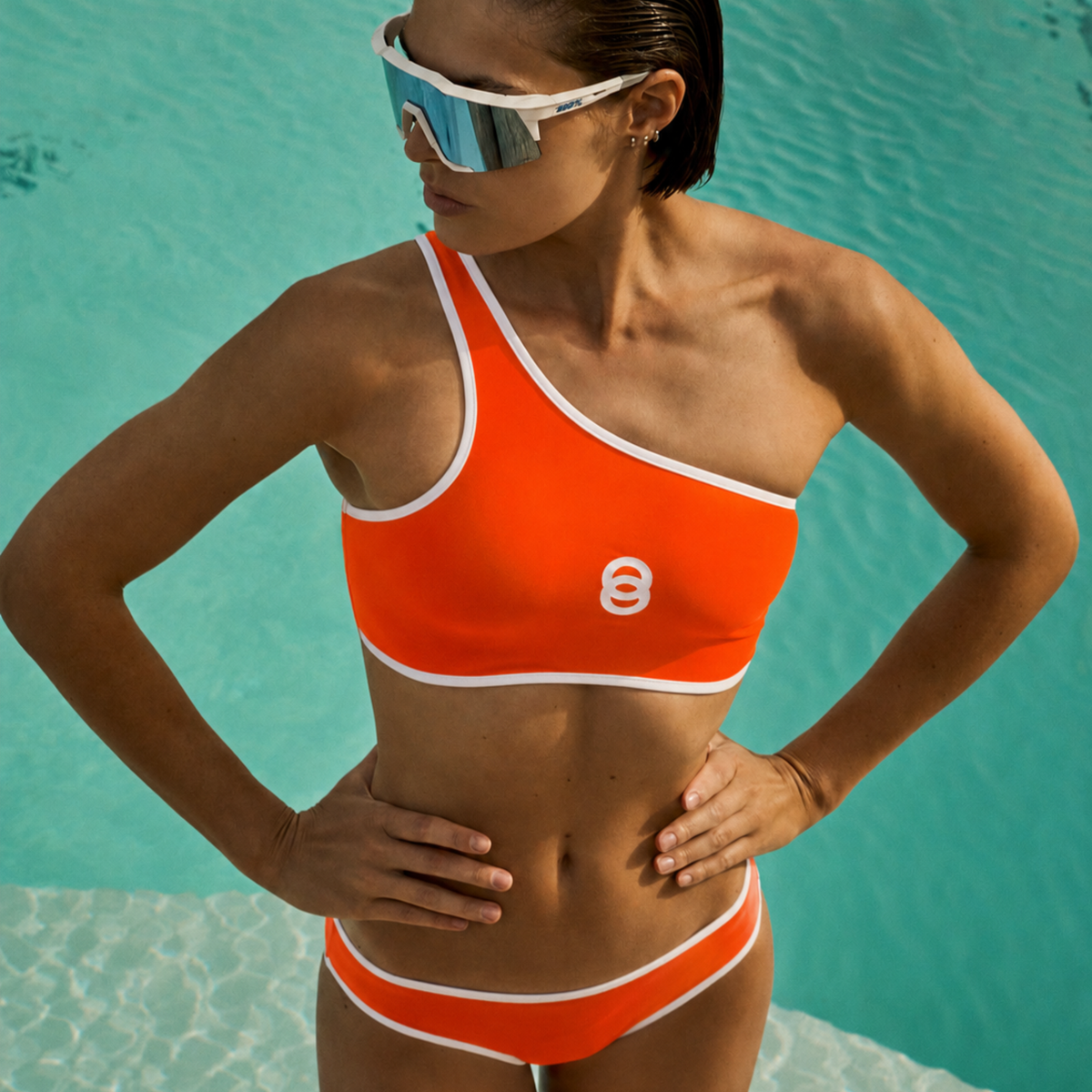
Our models stand out for their architectural lines, Italian technical fabrics, and cuts designed to accompany movement with elegance, from the pool to the beach.
Asymmetrical. Athletic. Graphic.
 Each silhouette extends the legacy of the bikini through a contemporary approach where the precision of the cuts, the quality of the materials, and the freedom of movement create a resolutely modern look.
CHLORE has always cultivated this encounter between chic and sport, between the rigor of the pool and the elegance of the female wardrobe.
80 years after its creation, the bikini continues to carry the same promise of freedom and movement. A timeless piece that traverses the eras without ever losing its modernity and of which CHLORE continues the story, in its own way, between architectural elegance and a sporty spirit.
Today, the bikini comes in an infinite variety of forms: triangle, bralette, high-waisted, asymmetrical, or sporty. A diversity that testifies to its incredible capacity to reinvent itself since its creation in 1946 and to accompany women in all their activities, from the beach to the pool.